
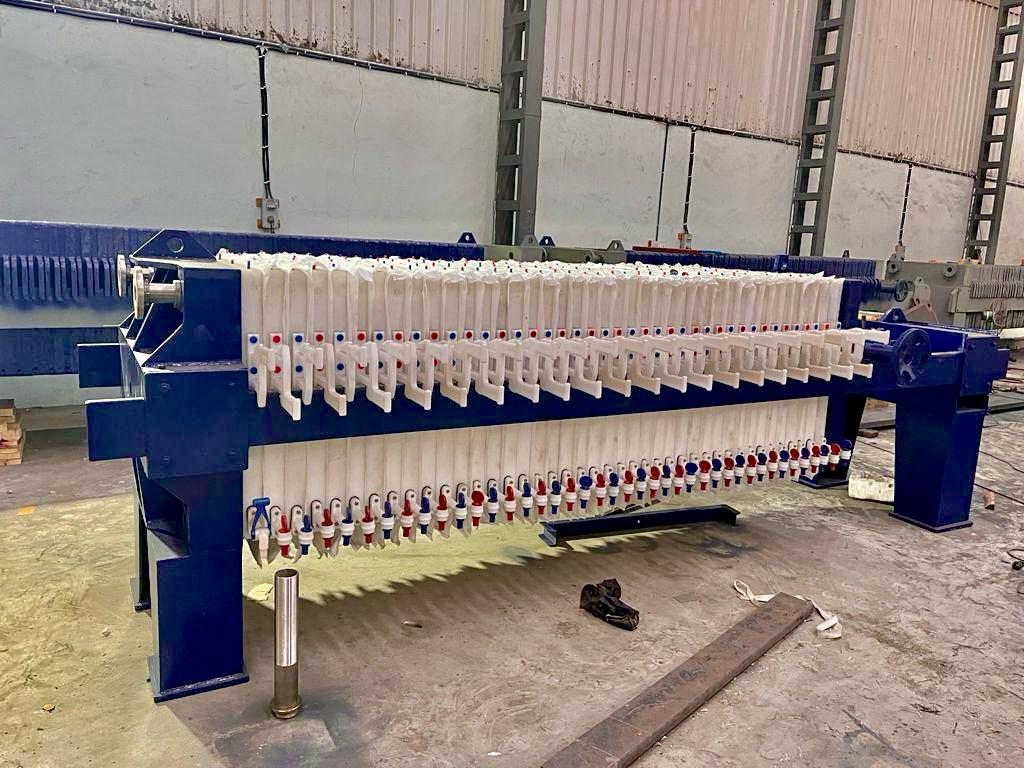
Description
Filter Press Functions
A filter press is a type of industrial equipment used for separating solids and liquids. It works by applying pressure to a slurry (a mixture of solid and liquid particles) to force the liquid through a filter medium, leaving the solid particles behind. The filtered liquid is then collected and the solid particles are removed from the filter plates.
The basic function of a filter press is to separate solid particles from a liquid in order to purify the liquid or to recover the solid particles. This process is commonly used in many industries, such as mining, food processing, wastewater treatment, and chemical manufacturing, to name a few.
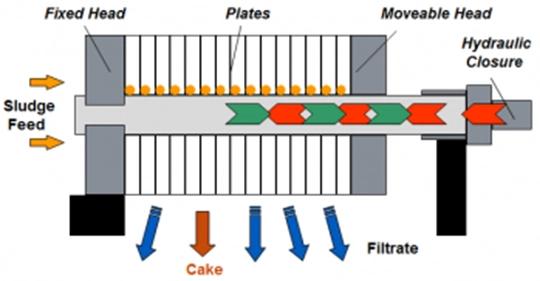
A filter press typically consists of a series of filter plates, each with a filter cloth or membrane, that are arranged in a stack. The slurry is introduced into the filter press and forced through the filter medium under pressure, separating the liquid and solid components. The filtered liquid is then collected and the solid particles are removed from the filter plates.
Filter presses can be used in a variety of applications and can be designed to handle a wide range of flow rates and solids concentrations. They can be configured as batch filter presses, where the entire process is carried out in a single cycle, or as continuous filter presses, where the filtration process is ongoing.
Overall, the function of a filter press is to separate solids and liquids, making it a useful tool for many industrial processes that require the separation of these components.

Reviews
There are no reviews yet.